Half your search traffic may not be search traffic at all
Someone typing your company name into Google was already coming to you. Counting them as an SEO win is the most common way a site convinces itself things are going well while the part that finds new customers quietly shrinks.
Last updated 2026-09-04 · The Clode team · Guides
The short version
Split your queries into brand (your name and its misspellings) and non-brand (everything else) and read the two separately. Brand traffic follows your marketing and reputation. Non-brand traffic is the part SEO actually moves. A flat total made of rising brand and falling non-brand is the most commonly missed bad news in search.
Why the split matters more than any other
The two halves answer different questions and respond to different work. Brand searches go up when someone sees an advert, hears about you, or has been to your site before. They measure awareness, and they usually convert well because the person had already decided.
Non-brand searches ("electrician near me", "best dog food for puppies") are people who do not know you exist yet. That is the number that tells you whether your site is winning anyone new, and it is the only one that meaningfully responds to writing better pages.
Averaged together they hide each other. A flat total is regularly a rising brand line covering a falling non-brand one, which is a business getting worse at acquisition while its dashboard says nothing changed.
2,400 clicks in the first month, 2,400 in the twelfth.
Brand went from 980 up to 1,420. Non-brand went from 1,420 down to 980.
Defining "brand" without overthinking it
Anything containing your company name counts, including the ways people get it wrong. Cover misspellings, spacing variants, your domain typed as a search, your name plus a location or a product, and the names of your own products if they are distinctive.
Two judgement calls come up. Your own name plus a competitor's ("acme vs beta") counts as brand, because they already know you. A generic word that happens to be your company name is the hard case, and the practical answer is to include it and note that the brand figure is an overestimate, rather than to leave a large chunk uncategorised.
What to do with each half
| Brand up | Brand down | |
|---|---|---|
| Non-brand up | Healthy growth. People who already know you and people who did not are both finding you more often. | Look off-site. Your SEO is still winning new people, and a brand fall is rarely an SEO problem: a campaign ended, a reputation issue, a seasonal lull in demand for you specifically. |
| Non-brand down | The one people miss. The total can stay flat while the business gets worse at acquisition and its dashboard says nothing changed. | Both falling. Look for something site-wide and technical before anything else. |
Brand rising, non-brand flat.
Your marketing is working and your SEO is not compounding. Expect no new customers from search that you did not already pay to acquire.
Non-brand rising, brand flat.
The healthy shape. New people are finding you; the awareness will follow.
How this works in Clode
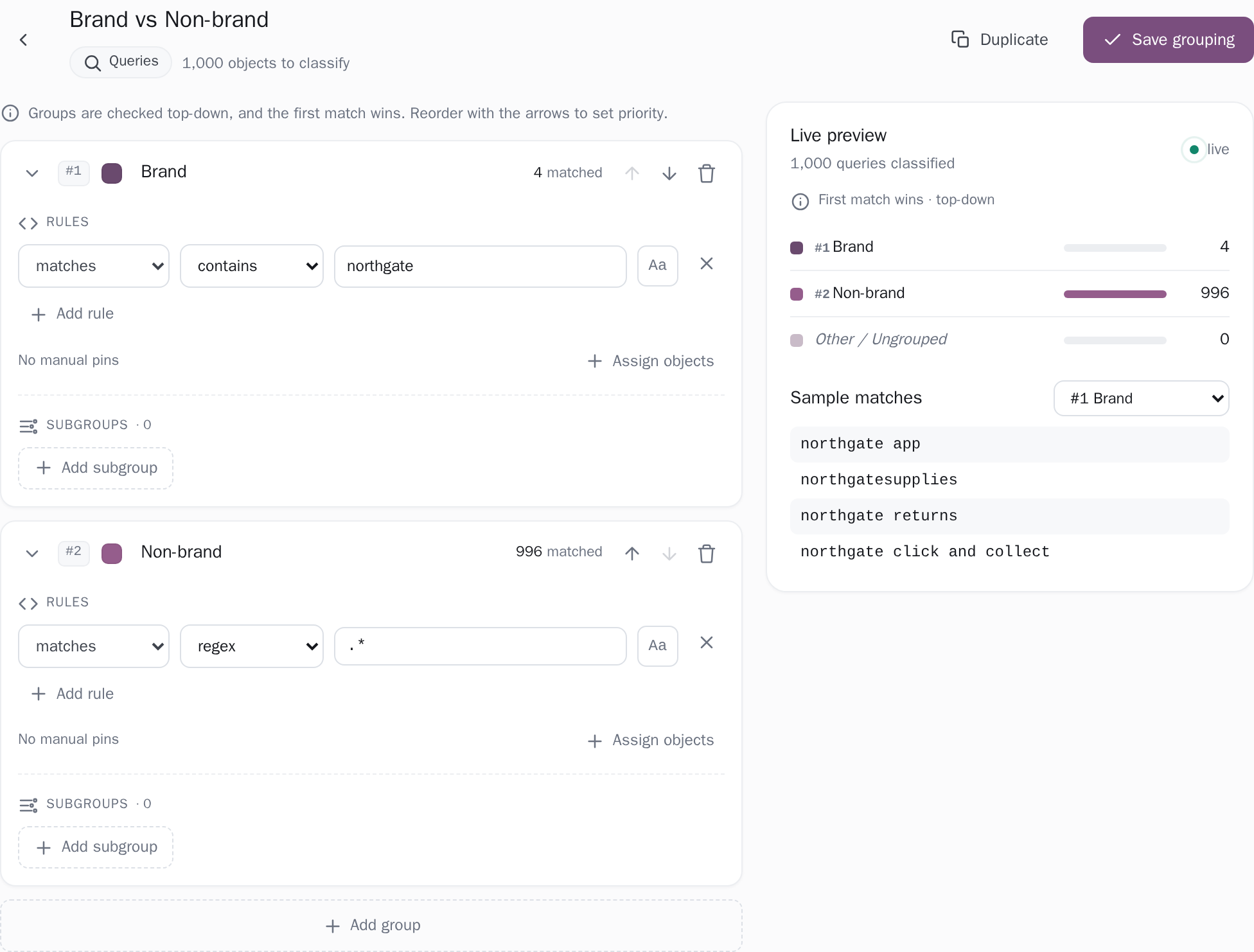
Clode builds this split for you on the first sync, starting from your site's own name, as a grouping you can edit to add the misspellings. The dashboard shows the two halves, and in the pivot table Brand status is a dimension you can set against Date to see which of the four shapes above is yours.
Doing it in Search Console
Filter the Queries report to "query contains" your brand name for one number, then "query does not contain" for the other. It works, and you have to redo it every time, for every date range, for every page you look at. It also handles only one spelling at a time.
How we do it
Brand is a group: a rule, or a set of rules with all the misspellings in it, defined once. After that every report in Clode (the trend chart, the winners and losers, the pivot table, the alerts) can be read as brand, non-brand or both, and new queries fall into the right side automatically as they appear.
The dashboard shows both lines from the start, because on most sites the first time anyone sees them separately is the most useful minute they spend with the product.